
Understanding Covered Calls: Generate Income From Your Stock Holdings
What Is A Covered Call?
A covered call is a two-part strategy: you own shares of a stock and sell (write) a call option on those same shares. The “covered” part means you already own the stock, protecting you if the option is exercised.
When you sell a call option, you give someone else the right to buy your shares at a specific price (strike price) by a certain date. In exchange, you receive immediate cash called the premium.
One call option contract represents 100 shares. To sell a covered call, you need to own at least 100 shares of the underlying stock.
Three Possible Outcomes
Stock Stays Flat or Falls
Stock price stays below the strike price at expiration.
What Happens:
- Option expires worthless
- You keep your shares
- You keep the premium
- You can repeat the strategy
Stock Rises Moderately
Stock rises but stays below or at the strike price.
What Happens:
- Option expires worthless
- You keep your shares
- You keep the premium
- You enjoy stock price gains
Best Case Scenario
Stock Rises Significantly
Stock rises above the strike price at expiration.
What Happens:
- Shares get "called away"
- You sell at strike price
- You keep the premium
- Miss gains above strike
Real-World Example
- Initial Setup
| Stock Owned | 100 shares of XYZ |
| Current Stock Price | $32.00 per share |
| Call Strike Price | $35.00 |
| Expiration | 30 days |
| Premium Received | $200 |
Possible Outcomes at Expiration
If stock at $30:
Stock loss: -$200 | Premium: +$200
Net: $0 (break even)
If stock at $34:
Stock gain: +$200 | Premium: +$200
Net: +$400 profit
If stock at $40:
Shares sold at $35: +$300 | Premium: +$200
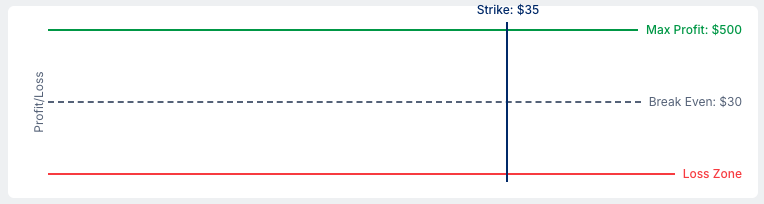
Net: +$500 (but missed $500 above strike)
Profit/Loss Diagram
Benefits & Considerations
Benefits
Generate Income
Collect premium immediately, regardless of what happens
Downside Protection
Premium provides a small cushion against losses
Repeatable Strategy
Can be executed monthly or quarterly for consistent income
Lower Risk
Considered one of the safest options strategies
Considerations
Limited Upside
You cap your potential gains at the strike price
Shares May Be Called Away
If stock rises above strike, you must sell your shares
Doesn't Prevent Losses
Premium only partially offsets a significant decline
Market Timing
Works best in flat or slowly rising markets